
Programmatic Ecosystem Explained

How Every Impression Becomes an Advertisement

Every impression tells a story. Here's who reads it first.

Understanding the Programmatic Advertising Ecosystem

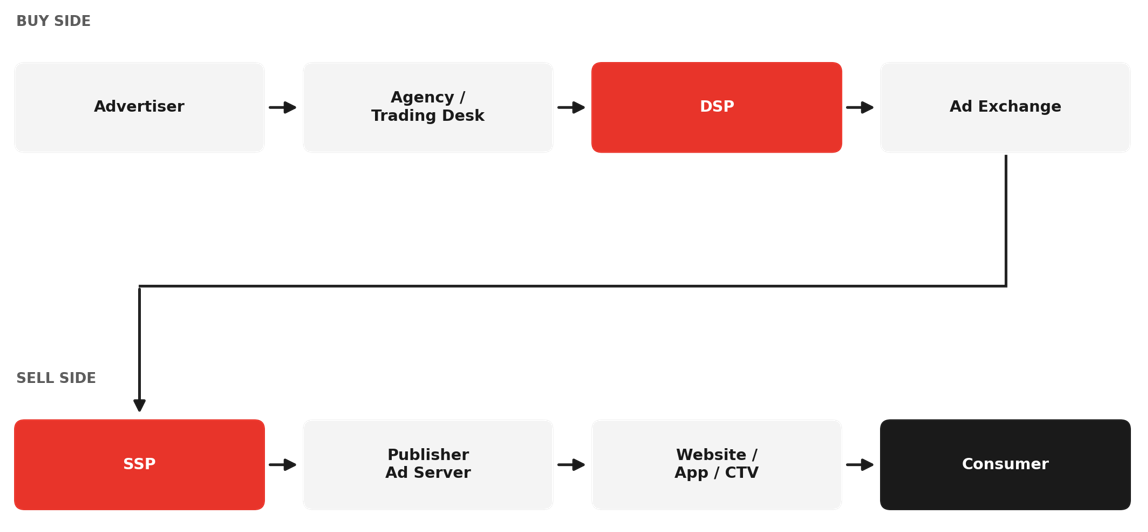
Every time a consumer opens a website or app, an advertising opportunity—known as an impression—is created. Within milliseconds, multiple technology platforms work together to determine which advertiser wins the opportunity to show an ad. This interconnected network of platforms is the programmatic advertising ecosystem.

Programmatic buying types
CAMPAIGN OWNER

Advertiser

Defines campaign objectives, audiences, budgets and creatives with the goal of reaching the right consumer while maximising return on media investment.

Objectives Audience Budget Creative
THE BUYER

DSP

Evaluates available impressions, analyses audience and contextual signals, determines bid value and participates in real-time auctions on behalf of advertisers.

Audience targeting Bid optimisation Budget management Frequency capping Measurement
THE MARKETPLACE

Ad Exchange

Connects buyers and sellers, receives bids from multiple DSPs and runs the real-time auction to determine the winning advertiser.

Real-time auctions Bid routing Marketplace liquidity Price discovery
THE SELLER

SSP

Represents publishers and manages available inventory, pricing rules and demand partners to maximise the value of every advertising opportunity.

Monetisation Yield optimisation PMP management Floor pricing Demand integrations
INVENTORY CONTROL

Publisher Ad Server

Manages available inventory, determines which ads are eligible to compete, prioritises campaigns and delivers the winning creative to the user.

Inventory management Creative delivery Campaign priority Forecasting Reporting

How the Money Flows

Every hop between advertiser and publisher exists because it adds technology, infrastructure, or optimisation capability and every hop also takes a fee out of the budget before it reaches the publisher.

01
MEDIA OWNER

Advertiser

Provides the media investment and campaign objectives.

02
BUYING STRATEGY

Agency / Trading Desk

Manages media strategy, planning and campaign execution.

Service fee
03
BUYING TECHNOLOGY

DSP

Evaluates impressions and executes automated media buying.

Platform fee
04
MARKETPLACE

Ad Exchange

Runs auctions and connects buyers with available supply.

Exchange fee
05
SUPPLY TECHNOLOGY

SSP

Optimises inventory value and manages publisher demand.

Supply fee
06
FINAL DESTINATION

Publisher

Receives the remaining net media revenue.

The gap between what an advertiser spends and what a publisher earns is often called the “ad tech tax”—part of what Supply Path Optimisation exists to reduce.

Why the Ecosystem Is Evolving

For years, programmatic focused primarily on automating transactions. Today, advertisers expect far more than efficient buying—they want transparency, premium environments, attention measurement, and richer contextual intelligence.

This has driven the rise of curation, Supply Path Optimisation (SPO), and signal-rich marketplaces, where every impression is evaluated not just on availability, but on the quality of the information attached to it.

At Klarion, we believe the future of programmatic lies in helping buyers make better decisions before every bid. By combining premium supply, intelligent curation, contextual signals, and attention insights, we turn traditional media buying into a more transparent, efficient, and intelligent marketplace.

One impression. Six intermediaries. One story worth understanding.