
OTT, CTV & FAST Explained

Understanding the Future of Television Advertising

Television isn't disappearing. It's evolving.

The Evolution of Television

For decades, television advertising followed a predictable model. Brands bought airtime on broadcast or cable networks to reach the largest possible audience, with success measured largely by reach and frequency. Today, that landscape has changed dramatically—viewers consume content across smart TVs, streaming devices, mobile phones and tablets, while advertisers now have access to precision targeting, programmatic buying, and real-time measurement.

This shift has introduced three terms that get used interchangeably—OTT, CTV, and FAST. They're closely related, but they describe different parts of the same streaming ecosystem. Understanding the distinction matters for building an effective premium video strategy.

OTT, CTV & FAST at a Glance

01

What Is OTT?

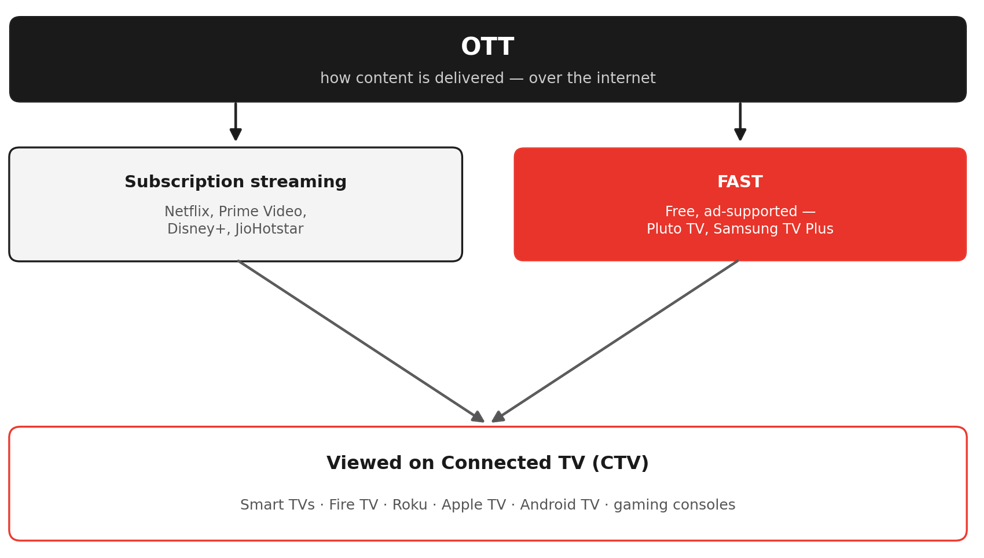
OTT (Over-The-Top) refers to the delivery of television and video content over the internet, bypassing traditional cable, satellite, and broadcast providers. Rather than describing a device, OTT describes how content reaches the viewer.

Netflix Amazon Prime Video Disney+ YouTube JioHotstar Sony LIV Pluto TV Samsung TV Plus

OTT content can be consumed on smartphones, tablets, laptops, desktops, and smart televisions—think of OTT as the ecosystem that enables internet-based television.
02

What Is Connected TV (CTV)?

Unlike OTT, Connected TV (CTV) refers to the device or screen used to watch streamed video content. A CTV is any television connected to the internet, either directly or through an external streaming device—Smart TVs, Apple TV, Amazon Fire TV, Roku, Android TV, Chromecast, or gaming consoles like Xbox and PlayStation.

Smart TVs Apple TV Amazon Fire TV Roku Android TV Chromecast Xbox PlayStation

OTT describes how content is delivered. CTV describes where it's viewed. al television, but the content

03

What Are FAST Channels?

FAST stands for Free Ad-Supported Streaming Television. Unlike subscription platforms, FAST channels provide free access to professionally curated television channels funded entirely by advertising—recreating the familiar experience of traditional linear television. Instead of choosing individual episodes on demand, viewers simply tune into scheduled channels covering genres like News, Sports, Movies, Entertainment, Lifestyle, Kids, and Music.

Pluto TV Samsung TV Plus LG Channels Rakuten TV TCL Channel

The viewing experience resembles traditional television, but the content

How OTT, CTV and FAST Fit Together

One of the biggest misconceptions in the industry is that OTT, CTV, and FAST are competing technologies. In reality, they describe different layers of the same streaming ecosystem: OTT is the ecosystem, CTV is the screen, and FAST is one of the services within that ecosystem.

Programmatic buying types

Why Advertisers Are Investing in CTV and FAST

Television with digital precision.

Consumer viewing habits have changed dramatically over the past decade. Audiences increasingly prefer streaming because it offers greater content choice, flexible viewing, better content discovery, cross-device accessibility, and high-quality viewing experiences.

For advertisers, streaming combines television's emotional impact with digital advertising's precision. Instead of buying broad demographic audiences, brands can target viewers using:

  • Geography & household characteristics
  • Contextual & first-party signals
  • Viewing behaviour
  • Device intelligence

Why FAST Is One of the Fastest-Growing Segments

Free viewing. Premium opportunity.

FAST has emerged as one of the fastest-growing areas of streaming because it addresses a real consumer pain point: subscription fatigue. As households accumulate multiple paid streaming subscriptions, many viewers are actively seeking free alternatives without compromising on content quality—and FAST delivers exactly that.

For advertisers, FAST offers several compelling advantages:

  • Premium television environments
  • Large-screen viewing experiences
  • High attention levels
  • Brand-safe content
  • Addressable audience targeting
  • Programmatic buying capabilities
  • Rich measurement and reporting

How Programmatic Fits Into the Streaming Ecosystem

Connecting the streaming ecosystem.

Modern CTV and FAST advertising is increasingly transacted through programmatic platforms. Rather than negotiating campaigns manually, advertisers can access premium streaming inventory through DSPs, SSPs, private marketplaces, and curated supply paths.

Programmatic CTV enables advertisers to:

  • Reach premium audiences at scale
  • Apply contextual and audience targeting
  • Optimise campaign frequency
  • Measure performance in real time
  • Access multiple publishers through a single buying platform

Klarion's Perspective

At Klarion, we believe streaming represents far more than another advertising channel—it represents the future of premium media.

The opportunity isn't simply to buy more CTV impressions. It's to buy better impressions—combining premium streaming environments with rich contextual signals, attention intelligence, transparent supply paths, intelligent curation, and trusted publisher relationships.

Whether inventory comes from a broadcaster, a premium OTT platform, or a FAST channel, every impression should give advertisers the intelligence needed to make a better buying decision.

The screen changed. The standard for intelligence shouldn't.